


California Academy of Sciences: From Leaf to Landscape
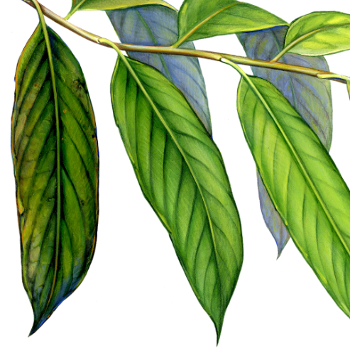
A rainforest’s ability to take a deep breath depends on a somewhat surprising factor—the age of its leaves.
When Scott Saleska first began studying the Amazon rainforest, he knew the critical role that forests play in the health of the planet. As trees in the forest photosynthesize, they produce life-giving oxygen and pull in carbon dioxide—including some of what humans pump into the atmosphere as we burn fossil fuels. But the trees’ rate of photosynthesis isn’t constant. Before launching their nearly two-decade-long study, Saleska and his colleagues assumed—based on research in temperate forests and on ecological models—that photosynthesis would peak during the wet season, when the rainforest appears to be at its lushest. When the scientists looked closely, though, they found just the opposite: The rainforest, at least in in north-central Brazil’s Tapajós National Forest, is most productive when conditions are driest. To understand why, and what these findings might mean for the health of the forest in a changing climate, the researchers have studied the ecosystem at every possible scale—from leaf to landscape
The mission of the California Academy of Sciences is to explore, explain, and sustain life.
These immersive infographics and data visualizations make great interactive learning resources for secondary students or science teachers.
What are you looking for?
Organization
Website URL
Type of Resource
Assigned Categories
Resource k12
A rainforest’s ability to take a deep breath depends on a somewhat surprising factor—the age of its leaves.
When Scott Saleska first began studying the Amazon rainforest, he knew the critical role that forests play in the health of the planet. As trees in the forest photosynthesize, they produce life-giving oxygen and pull in carbon dioxide—including some of what humans pump into the atmosphere as we burn fossil fuels. But the trees’ rate of photosynthesis isn’t constant. Before launching their nearly two-decade-long study, Saleska and his colleagues assumed—based on research in temperate forests and on ecological models—that photosynthesis would peak during the wet season, when the rainforest appears to be at its lushest. When the scientists looked closely, though, they found just the opposite: The rainforest, at least in in north-central Brazil’s Tapajós National Forest, is most productive when conditions are driest. To understand why, and what these findings might mean for the health of the forest in a changing climate, the researchers have studied the ecosystem at every possible scale—from leaf to landscape
The mission of the California Academy of Sciences is to explore, explain, and sustain life.
These immersive infographics and data visualizations make great interactive learning resources for secondary students or science teachers.
