

Environmental Protection Agency: Climate Change Indicators - Glaciers
This indicator examines the balance between snow accumulation and melting in glaciers, and it describes how glaciers in the United States and around the world have changed over time.
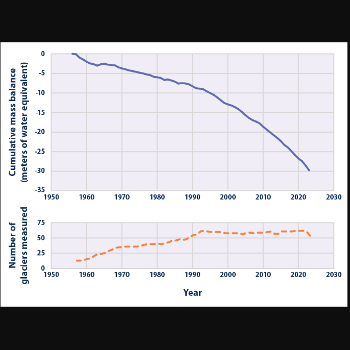
This indicator is based on long-term monitoring data collected at selected glaciers around the world. Scientists collect detailed measurements to determine glacier mass balance, which is the net gain or loss of snow and ice over the course of the year. A negative mass balance indicates that a glacier has lost ice or snow. If cumulative mass balance becomes more negative over time, it means glaciers are losing mass more quickly than they can accumulate new snow.
Figure 1 shows trends in mass balance for a set of 40 reference glaciers around the world that have been measured consistently since the 1970s, including a few that have been measured since the 1940s. Data from these reference glaciers have been averaged together to depict changes over time. Figure 2 shows trends for three “benchmark” glaciers: South Cascade Glacier in Washington state, Wolverine Glacier near Alaska’s southern coast, and Gulkana Glacier in Alaska’s interior. These three glaciers were chosen because they have been studied extensively by the U.S. Geological Survey for many years and because they are thought to be representative of other glaciers nearby.
This indicator describes the change in glacier mass balance, which is measured as the average change in thickness across the surface of a glacier. The change in ice or snow has been converted to the equivalent amount of liquid water.
Learn how air pollution can harm your health and the environment, and what EPA is doing to protect the air we breathe.
Understanding and addressing climate change is critical to EPA’s mission of protecting human health and the environment.
EPA partners with more than 40 data contributors from various government agencies, academic institutions, and other organizations to compile a key set of indicators related to the causes and effects of climate change.
This chapter focuses on trends in snow, glaciers, and the freezing and thawing of oceans and lakes.
What are you looking for?
Organization
Website URL
Type of Resource
Assigned Categories
Resource k12
This indicator examines the balance between snow accumulation and melting in glaciers, and it describes how glaciers in the United States and around the world have changed over time.
This indicator is based on long-term monitoring data collected at selected glaciers around the world. Scientists collect detailed measurements to determine glacier mass balance, which is the net gain or loss of snow and ice over the course of the year. A negative mass balance indicates that a glacier has lost ice or snow. If cumulative mass balance becomes more negative over time, it means glaciers are losing mass more quickly than they can accumulate new snow.
Figure 1 shows trends in mass balance for a set of 40 reference glaciers around the world that have been measured consistently since the 1970s, including a few that have been measured since the 1940s. Data from these reference glaciers have been averaged together to depict changes over time. Figure 2 shows trends for three “benchmark” glaciers: South Cascade Glacier in Washington state, Wolverine Glacier near Alaska’s southern coast, and Gulkana Glacier in Alaska’s interior. These three glaciers were chosen because they have been studied extensively by the U.S. Geological Survey for many years and because they are thought to be representative of other glaciers nearby.
This indicator describes the change in glacier mass balance, which is measured as the average change in thickness across the surface of a glacier. The change in ice or snow has been converted to the equivalent amount of liquid water.
Learn how air pollution can harm your health and the environment, and what EPA is doing to protect the air we breathe.
Understanding and addressing climate change is critical to EPA’s mission of protecting human health and the environment.
EPA partners with more than 40 data contributors from various government agencies, academic institutions, and other organizations to compile a key set of indicators related to the causes and effects of climate change.
This chapter focuses on trends in snow, glaciers, and the freezing and thawing of oceans and lakes.
