

NRICH: Crossed Ends

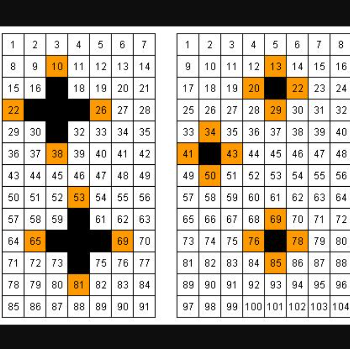
Crosses can be drawn on number grids of various sizes. What do you notice when you add opposite ends?
These crosses can be drawn on number grids of various sizes.
Add opposite pairs of orange numbers
(i.e. north + south, east + west).
Notice anything?
Try a few more.
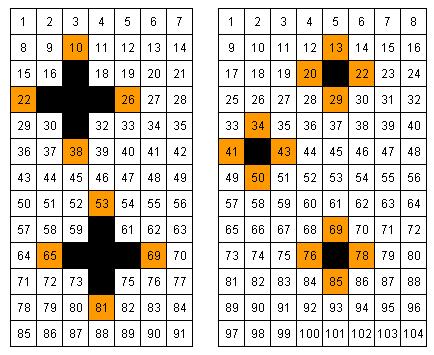
Now try adding opposite pairs on crosses with just two lines of symmetry, like these:
What do you notice?
Can you explain your findings?
Experiment with grids of various sizes.
You may find these printable sheets useful:
Number Grids – width 3, 4, 5 and 6
Number Grids – width 7 and 8
Number Grids – width 9 and 10
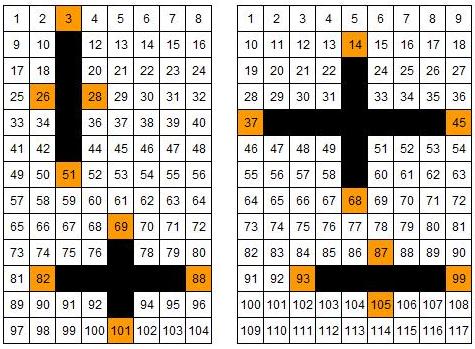
What happens if you add the orange squares in adjacent pairs? (try N + W, S + E )
Can you predict in advance how the totals will relate to each other?
What does it depend on?
Is it the same if you added them the other way round? (i.e. N + E, S + W)
Can you explain your findings?
Age 11 to 14
Crosses can be drawn on number grids of various sizes. What do you notice when you add opposite ends?
These crosses can be drawn on number grids of various sizes.
Add opposite pairs of orange numbers
(i.e. north + south, east + west).
Notice anything?
Try a few more.
Now try adding opposite pairs on crosses with just two lines of symmetry, like these:
What do you notice?
Can you explain your findings?
Experiment with grids of various sizes.
You may find these printable sheets useful:
Number Grids – width 3, 4, 5 and 6
Number Grids – width 7 and 8
Number Grids – width 9 and 10
What happens if you add the orange squares in adjacent pairs? (try N + W, S + E )
Can you predict in advance how the totals will relate to each other?
What does it depend on?
Is it the same if you added them the other way round? (i.e. N + E, S + W)
Can you explain your findings?
Age 11 to 14